
Onyx Tiles: What It Is, Where It Works, and Whether It's Worth It
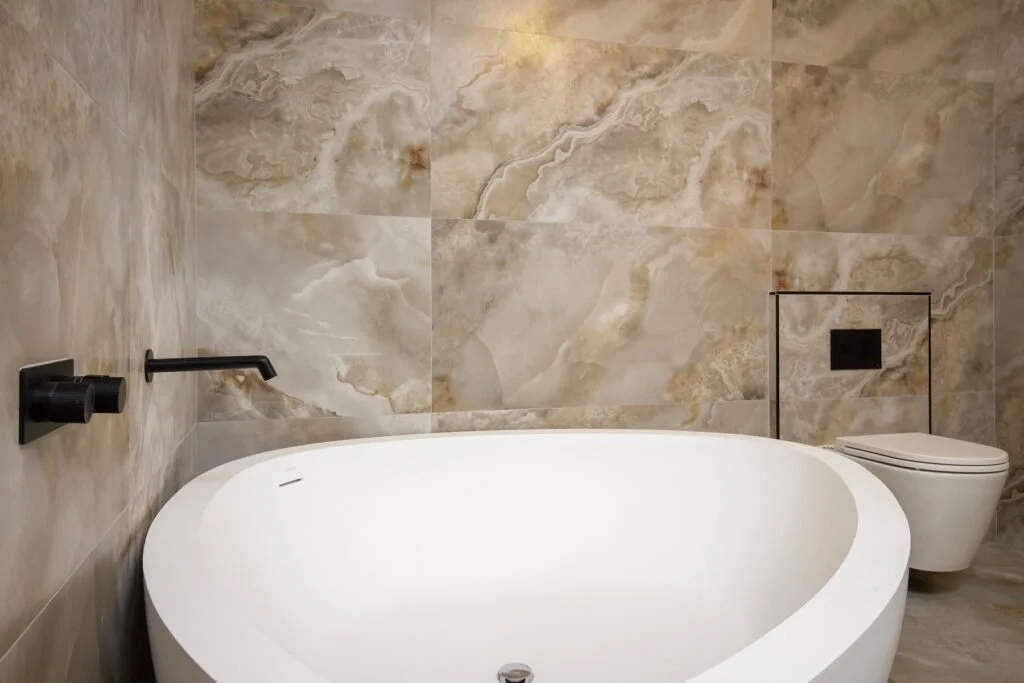
Onyx tiles for bathroom
Onyx is the stone that stops people mid-scroll. The translucency, the dramatic veining, the depth of colour, there's nothing quite like it.
But it also raises the most questions: Is it practical? Is it durable? Is it worth the investment?
This guide covers everything you need to know about natural onyx stone, from where it works in your home in Malaysia to how it compares against granite stone and standard tiles.
TLDR: What Should You Know Before Choosing Onyx Stone?
If you're considering onyx stone Malaysia for your home, the first thing to know is that onyx is chosen for its appearance rather than its durability.
One of the biggest onyx stone benefits is its ability to create stunning feature walls, vanity tops, reception counters, and statement spaces that simply cannot be replicated by other materials.
When it comes to onyx color options, Honey and White Onyx are particularly sought after for residential projects because they work beautifully with both modern and classic interiors.
In terms of cost, onyx stone price is generally higher than standard granite and many marble varieties.
Onyx marble price varies significantly depending on colour, translucency, slab size, and rarity, with premium backlit-grade slabs commanding some of the highest prices in the natural stone market.
For homeowners comparing finishes, onyx stone tiles price is usually more affordable than full slabs, making tiles a practical option for feature walls and decorative surfaces while still achieving the signature onyx look.
As for applications, onyx stone tiles bathroom installations are where the material truly shines.
Bathrooms, powder rooms, vanity walls, and shower feature walls experience less wear and tear, allowing onyx to maintain its beauty for years. Backlit onyx walls are especially popular in luxury homes and hotels throughout Malaysia.
For kitchens, onyx stone tiles kitchen applications work best as splashbacks, kitchen islands, bar counters, or decorative features rather than heavy-use worktops. While beautiful, onyx is softer than granite and requires more care around heat, acids, and daily food preparation.
What Is Onyx Stone Tile?
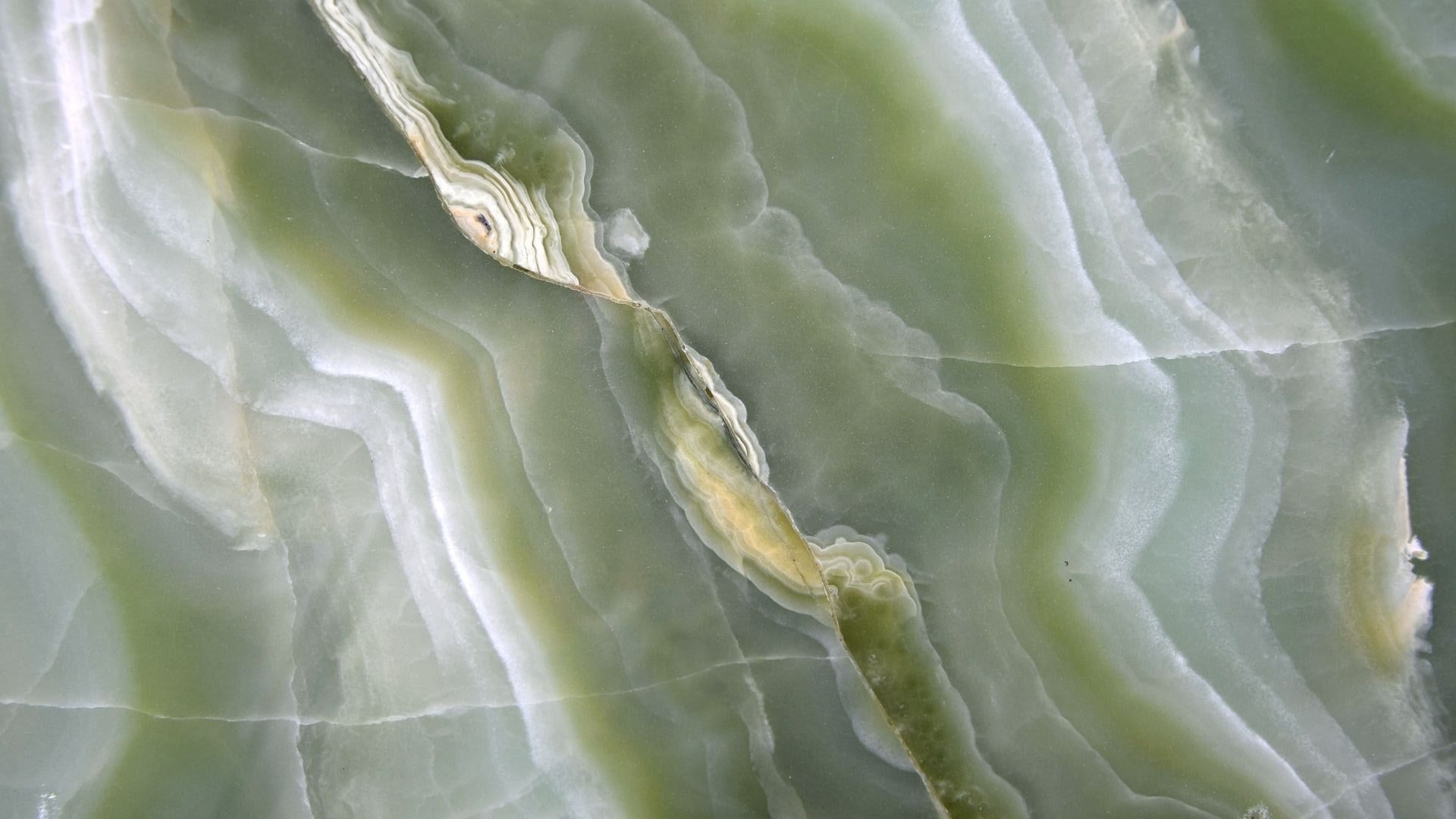
Onyx tiles
Onyx is a natural stone — but unlike granite (which is igneous) or marble (which is metamorphic), onyx is a sedimentary stone formed from calcium carbonate deposits in caves and springs.
That slow formation process is what gives it the banded, flowing patterns and, most distinctively, its translucency.
Cut thin enough — typically 18-20mm — and onyx allows light to pass through it.
That's not a property you find in granite, marble, or any engineered stone. It's what makes backlit onyx panels in bathrooms and feature walls such a dramatic effect.
Natural onyx stone is broadly categorised into a few families:
Honey / Amber Onyx — warm gold and amber tones with white banding. The most common variety in Malaysian projects.
White Onyx — near-white background with soft green or grey veining. Elegant, understated.
Green Onyx — deep green with lighter banding. Strong statement piece.
Black Onyx stone — deep black, sometimes with white or grey veining. High contrast, architectural feel.
Red / Pink Onyx — warm rose and coral tones. Rarest and most striking of the group.
Onyx Marble — a term used for certain stones that sit between true onyx and marble in composition. You'll hear this used interchangeably in the trade; the key distinction is translucency — true onyx transmits light, onyx marble usually doesn't to the same degree.
Each variety behaves slightly differently. Colour, banding pattern, and origin all affect how a slab looks — and price varies considerably across them.
Onyx Stone Tiles Bathroom: Where It Truly Belongs
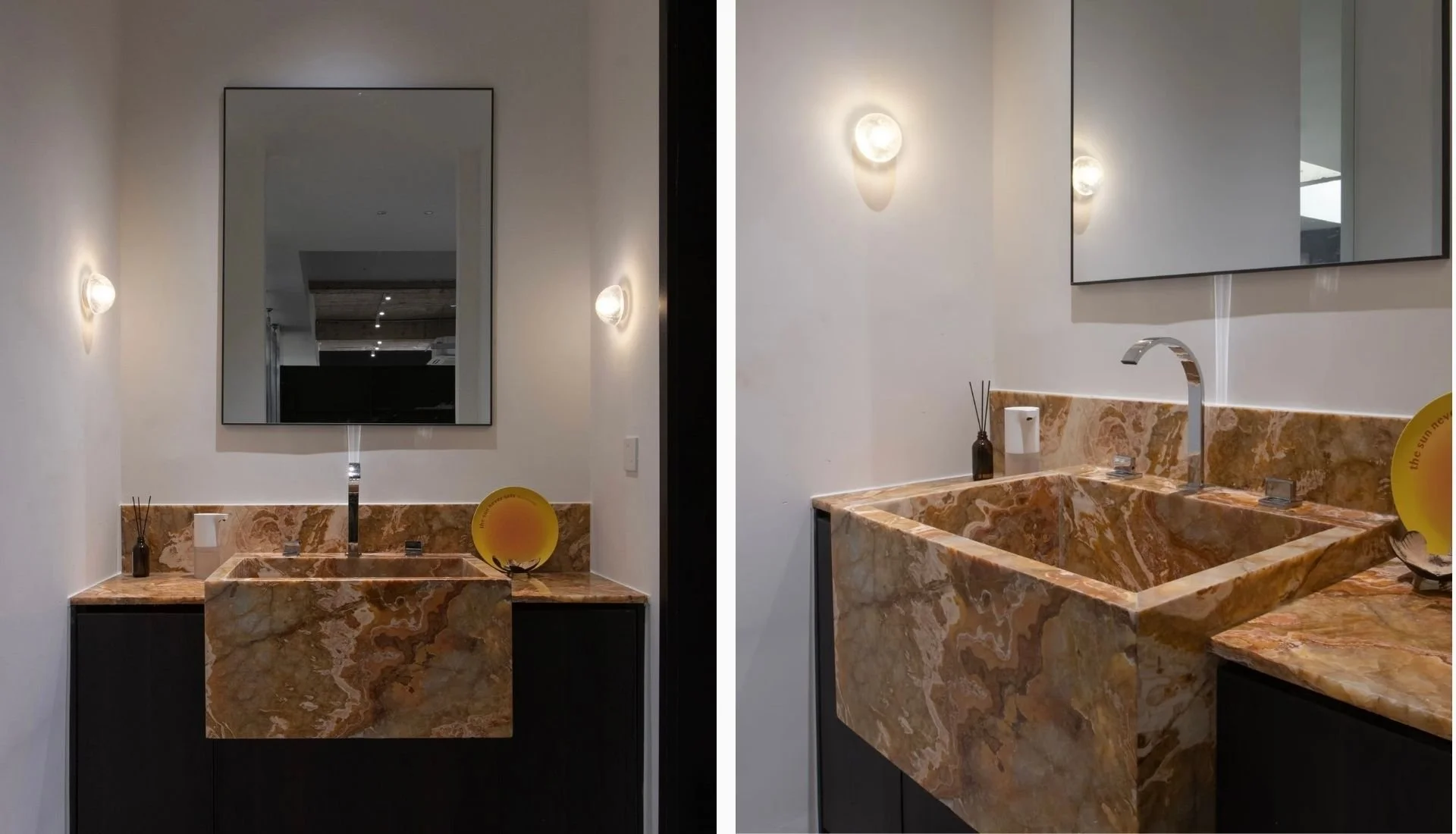
Onyx marble bathroom vanity sink
If there's one application where onyx stone earns its place without question, it's the bathroom.
Powder rooms and feature bathrooms in Malaysian condos and landed homes are where we see onyx used most effectively. A backlit onyx feature wall behind a vanity, an onyx vessel sink, or floor-to-ceiling onyx tiles in a wet room — these are interiors that hold their own in any market.
Why the bathroom specifically?
Bathrooms have lower mechanical stress than kitchens. There's no chopping, no hot pots, no heavy impact. Onyx is a relatively soft stone (around 6–7 on the Mohs scale, softer than granite) — it needs to be placed where it won't take constant abuse.
Bathrooms also allow you to play with lighting. Backlit onyx slabs installed behind LED panels create a glow that changes throughout the day — it's one of those effects that photographs beautifully and looks even better in person.
Practical notes for onyx stone tiles bathroom installations:
Use a penetrating sealer before and after installation — onyx is porous
Avoid harsh chemical cleaners; pH-neutral only
In wet areas, a honed finish has better grip than polished
Book-matching (mirroring adjacent slabs so the pattern flows) makes a significant visual difference — worth doing properly
Planning a feature bathroom with onyx?
Tell us your layout and we'll help you shortlist the right variant.
Onyx Stone Tiles Kitchen: Honest Advice
This is where we have to be straight with you.
Onyx stone tiles in a kitchen — specifically on the countertop — is a high-risk choice. It's not impossible, but it requires a homeowner who understands the material and is willing to maintain it.
Onyx is softer than granite and marble.
Malaysian cooking, the heat, the oil, the weight — puts more stress on a surface than most people realise. Onyx will scratch more easily, etch from acidic ingredients (tamarind, lime, vinegar), and stain if unsealed or if the seal wears off.
Where onyx does work in a kitchen:
Kitchen island top — lower traffic than the main prep area, primarily decorative
Splashback / backsplash — vertical surface, minimal mechanical stress, maximum visual impact
Bar counter or wet bar — drinks and glasses, not chopping boards
If you want onyx in your kitchen, use it where people will see it and where it won't take the full force of daily Malaysian cooking. Put your granite or sintered stone where the real work happens.
Is Onyx Better Than Granite?
Not a fair fight, they're for different jobs.
Granite wins on durability, practicality, and value for heavy-use surfaces. It's harder, more stain-resistant (when sealed), less reactive to acids, and available in a much wider price range. For a kitchen top that gets daily use, granite is the smarter call.
Onyx wins on drama.
Nothing else in the natural stone world gives you translucency, that depth of colour, or the visual weight that a well-placed onyx slab delivers. It's not competing with granite on performance — it's competing with it on presence.
The way we frame it to clients: if you want a surface that performs, granite. If you want a surface that stops people, onyx.
Most well-executed high-end interiors in KL use both, granite or sintered stone where durability matters, and onyx as the statement piece.
Onyx Stone Slab Vs Onyx Stone Tiles: Which To Use
Onyx stone slabs are for feature applications — backlit walls, full vanity tops, dramatic statement pieces.
Full slabs allow book-matching, which is where the real visual power of onyx comes from. You want the veining to mirror and flow across a surface, not break randomly at tile joints.
Onyx stone tiles are pre-cut, more accessible in budget terms, and easier to install across larger surface areas like floors or wall cladding. The trade-off is grout lines — on a busy onyx pattern, grout lines can interrupt the visual flow. On simpler, more banded varieties like honey onyx, tiles work well.
For bathrooms: if the wall is a feature point — go slab. If it's full wall cladding in a large bathroom — tiles are practical and still look excellent.
Onyx Stone Benefits: What You're Actually Getting
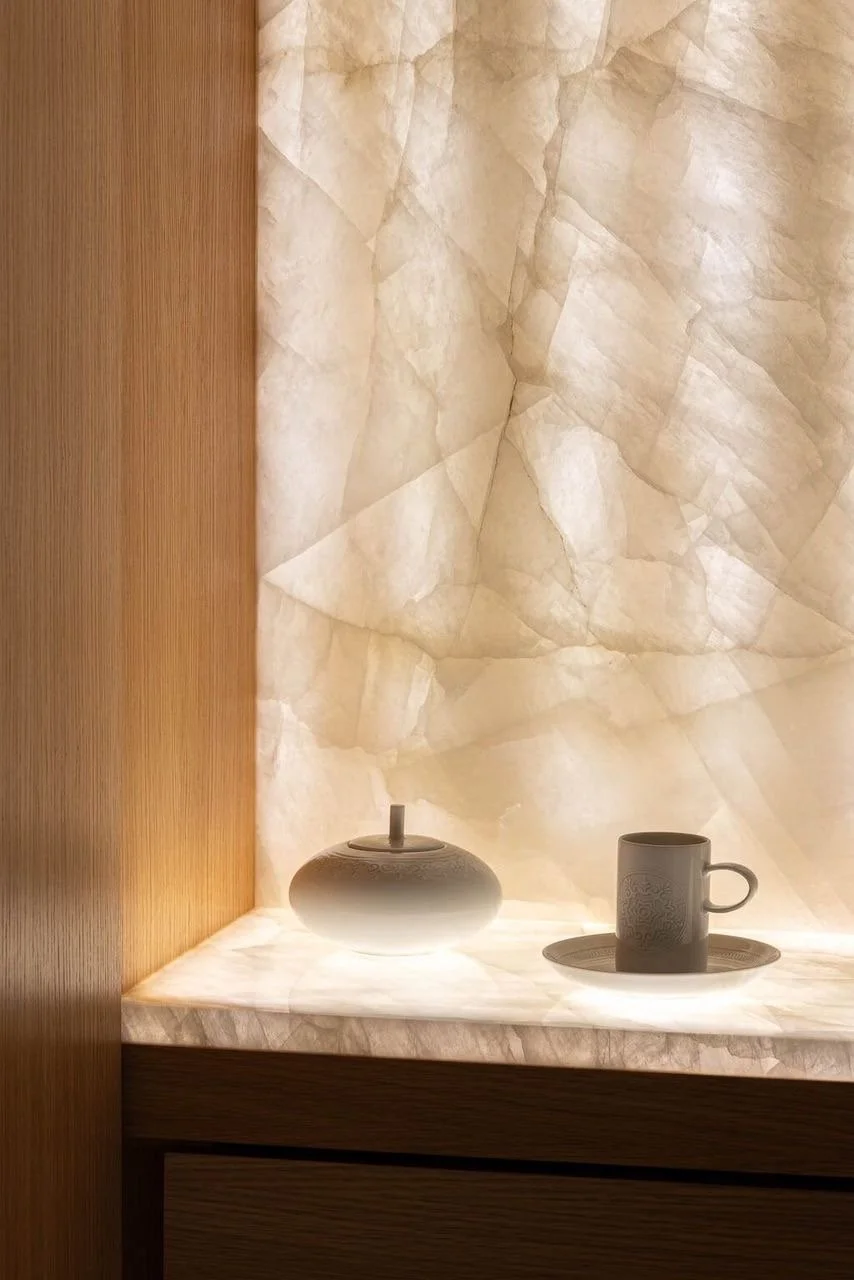
Onyx stone for feaure wall
Beyond the aesthetic, here's what natural onyx stone brings to a project:
Uniqueness — no two onyx slabs are alike. The banding, the colour transitions, the translucency variations — you're not getting something that looks like your neighbour's bathroom.
Backlit potential — no other commonly available stone does this. If you want a feature that genuinely looks different to anything in a showroom catalogue, backlit onyx is it.
Perceived value — onyx reads as premium, and correctly so. In residential projects in Malaysia, it significantly lifts the perceived value of a bathroom or reception area.
Longevity (in the right application) — properly installed and maintained onyx in a low-stress environment lasts. We've seen onyx bathrooms in KL that are over 15 years old and still look excellent.
What onyx is not: low maintenance. It requires attention.
If you're the kind of homeowner who wants to forget your stone exists — this is the wrong material.
Curious whether onyx makes sense for your specific project?
Contact us here and we'll give you an honest assessment.
Onyx Stone Price
Onyx is at the premium end of the natural stone market. Pricing shifts considerably based on variant, origin, slab size, and pattern rarity — more so than most other stones.
The factors that move the price most:
Variety and rarity: standard honey onyx is the most accessible. Red, pink, and certain green varieties are rarer and priced accordingly. Black onyx stone sits in the mid-to-upper range depending on the veining clarity.
Translucency quality: not all onyx is equally translucent. Higher translucency slabs — those that truly glow when backlit — command a premium because they're the minority of what's quarried.
Pattern consistency and book-match potential: slabs with clean, continuous banding that book-match well are more desirable and priced higher than those with erratic patterning.
Slab size: larger slabs mean fewer joins. In feature wall applications, a single unbroken slab looks dramatically better than multiple pieces joined. Larger slabs are harder to quarry and transport, so they cost more.
As a rough orientation: onyx sits in a similar tier to premium marble imports and above standard granite pricing, but with significantly more variation at the top end depending on the specific stone.
Some rare varieties are priced well above even the most expensive imported marbles.
The honest guidance: budget for onyx the way you'd budget for a statement piece, not a background material. That's exactly what it is.
Is Onyx A Good Tile?
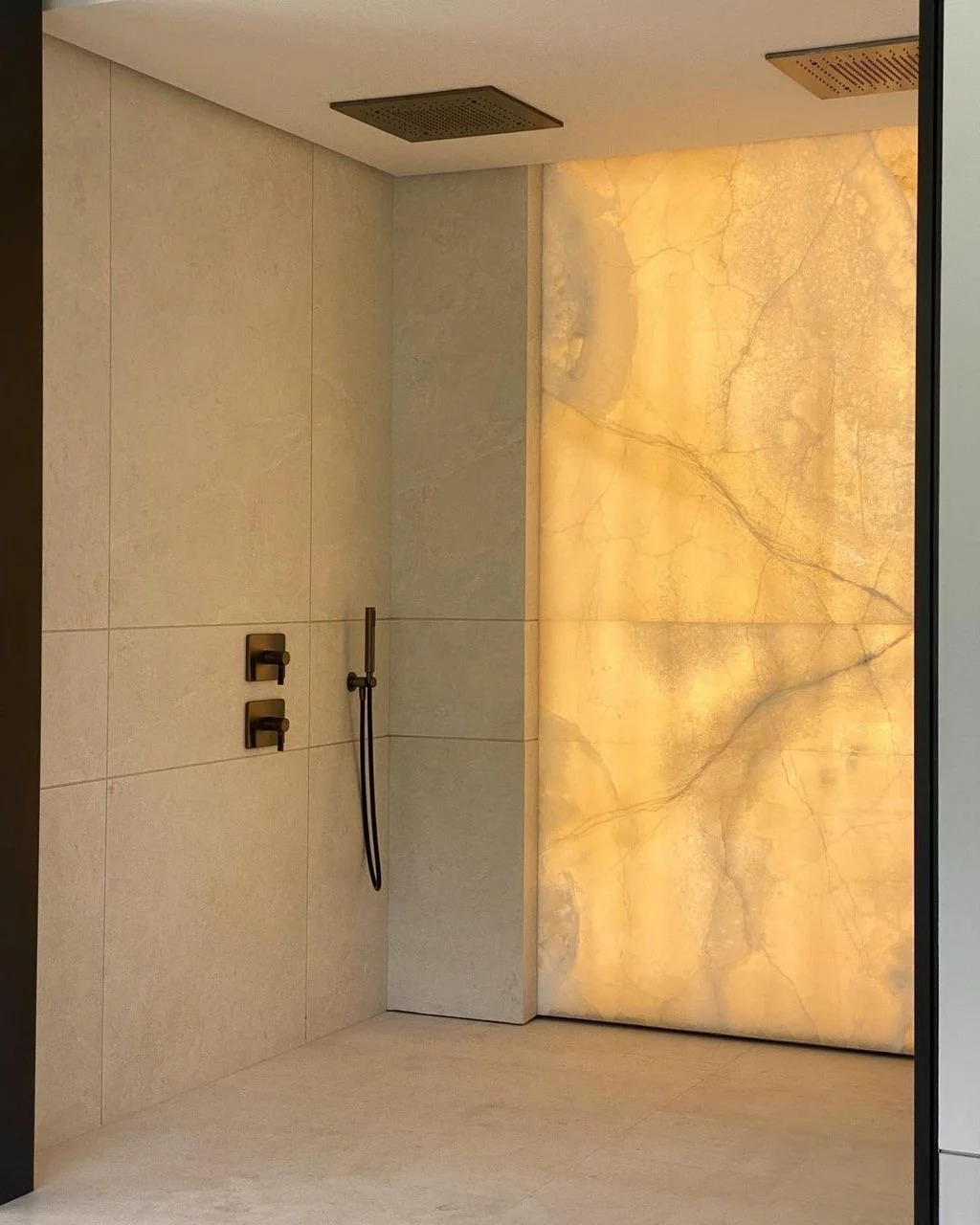
Onyx stone for bathroom wall
Yes, in the right application.
Onyx tiles are excellent for bathroom walls, feature walls, backsplashes, and low-traffic flooring where aesthetics take priority.
They're not the right choice for high-traffic floors, kitchen worktops, dining tables, or any surface that takes heavy daily use.
The material is beautiful but requires care — sealing, pH-neutral cleaning, and avoiding impact. If you understand that going in, onyx tiles deliver a result nothing else can match.
Is Onyx Cheaper Than Tile?

Onyx Stone Miele
No. Natural onyx stone is significantly more expensive than standard ceramic or porcelain tiles.
It's also more expensive than most entry-level marble tiles.
Onyx sits at the premium end of the natural stone market — the price reflects the rarity of the material, the complexity of quarrying and cutting it, and the visual quality of what you get.
If cost is the primary concern, onyx is probably not the right material.
If you want a result that standard tiles simply cannot achieve, it's a different conversation.
Quickzone: Onyx Stone Supplier In Malaysia
We supply and fabricate natural onyx stone for residential and commercial projects across Kuala Lumpur, Selangor, and the wider Klang Valley. Our range includes honey onyx, white onyx, green onyx, and black onyx stone, in both tile formats and full slabs.
We also handle backlit onyx panel installations, book-matched feature walls, and onyx vanity tops. If you're an interior designer specifying onyx for a project, we can work from your drawings and advise on slab selection before you commit.
Or come to our yard in Klang Valley to see the slabs in person. Onyx is one of those stones that has to be seen under natural light — photos on a screen don't capture the depth or translucency accurately.
Enquire here or WhatsApp us directly.
FAQs About Onyx Stone
-
Onyx is an excellent tile in the right setting — primarily bathrooms, feature walls, backsplashes, and decorative flooring in low-traffic areas.
It's not suited to heavy-use surfaces like kitchen countertops or high-traffic floors.
When used appropriately, onyx tiles deliver a visual result that ceramic or porcelain tiles simply cannot replicate.
-
Onyx stone tile is natural onyx that has been cut and finished into tile-sized pieces, typically for wall cladding, flooring, or feature applications.
Onyx is a sedimentary natural stone — formed from mineral-rich water depositing calcium carbonate in caves and springs over long periods. Its defining characteristic is translucency: thin-cut onyx allows light to pass through it, which is what makes backlit onyx installations so visually distinctive.
-
No — natural onyx stone is more expensive than standard ceramic or porcelain tiles, and more expensive than most basic marble tiles.
Pricing varies considerably based on the variety, rarity, pattern quality, and slab size, but onyx consistently sits at the premium end of the natural stone market.
If budget is the primary constraint, there are better options. If you want a result that standard tiles cannot deliver, the premium is generally justified.
-
The key benefits of natural onyx stone are its visual uniqueness, translucency, and the depth of character it brings to a space.
When backlit, onyx creates an effect that no other natural stone can replicate. In the right application — a powder room, a feature wall, a statement vanity — it significantly elevates the perceived quality of a space.
It also has good longevity when properly maintained in low-stress environments.
-
True onyx is a sedimentary stone with genuine translucency — light passes through it when it's cut thin enough.
Onyx marble (sometimes called marble onyx) refers to stones that share visual characteristics with onyx — banded patterning, rich colours — but have a different mineral composition and are usually less translucent or not translucent at all. In the Malaysian market, the terms are sometimes used loosely.
If translucency and backlighting are important to your project, confirm with your supplier that you're looking at true natural onyx, not a marble variety marketed under the same name.
-
Yes — with proper installation and maintenance.
Onyx needs to be sealed before and after installation, and resealed periodically.
Use only pH-neutral cleaners; avoid anything acidic or abrasive. In wet areas, a honed finish is safer than polished (less slippery).
With those basics in place, onyx in a bathroom holds up well over the long term.
-
Yes, onyx stone can be used for flooring, but it is best suited for low-traffic areas.
Unlike granite, onyx is a relatively soft natural stone and is more susceptible to scratches, chips, and surface wear over time. For this reason, onyx flooring is most commonly found in luxury bathrooms, hotel lobbies, reception areas, feature spaces, and decorative zones where foot traffic is lighter.
One of the biggest advantages of onyx flooring is its visual impact. The unique veining, rich colours, and translucent qualities create a premium look that few other materials can match.
For Malaysian homes, onyx stone flooring works particularly well in master bathrooms, powder rooms, and feature areas.
However, it is generally not recommended for busy family living rooms, kitchens, or outdoor areas where the floor is exposed to heavy traffic, dirt, moisture, and frequent impact.
-
Onyx is neither marble nor granite, although it is often confused with both.
Onyx is a sedimentary stone formed from calcium carbonate deposits left behind by mineral-rich water in caves, springs, and underground environments. This unique formation process creates the flowing bands, dramatic patterns, and translucent appearance that make onyx so distinctive.
While some suppliers market certain varieties as onyx marble, true onyx is valued for its translucency and ability to allow light to pass through the stone. This is why backlit onyx feature walls, vanity tops, and reception counters are so popular in luxury interior design.
Granite is typically the best choice for heavy-use surfaces such as kitchen countertops, while onyx is better suited for decorative applications such as feature walls, bathroom vanities, bar counters, and statement pieces.
Simply put, granite is chosen for durability, marble for elegance, and onyx for visual impact and translucency.

